
Author: DogsBlogSS Team
⚠️ Disclaimer: This article is for informational purposes only and is not a substitute for consulting a veterinarian.
jack russell parson russell
If you’ve ever found yourself staring at a lively little terrier and wondering, “Is that a Jack Russell or a Parson Russell?”, you’re not alone. These dogs share the same fiery spirit, the same clever spark in their eyes, and the same mischievous energy that keeps their owners on their toes. They even come from the same historical roots. But once you dig a little deeper, especially if you’re choosing a puppy or trying to understand your own dog better, the differences start to matter.
The Jack Russell and Parson Russell Terrier are often lumped together, which creates endless confusion for people browsing rescue pages, visiting breeders, or comparing photos online. Their shared ancestry goes all the way back to Reverend John “Jack” Russell, a 19th-century English hunting enthusiast who wanted a small, bold dog capable of going underground after foxes. Over time, different groups preserved his terriers in different ways—some focusing on show standards, others on working performance.
This split created the modern breeds we see today.
In this guide, we’ll break everything down clearly—appearance, temperament, lifestyle needs, training, and health—so you can finally understand the real difference between Jack Russell Terriers and Parson Russell Terriers. We’ll also pull in advice from trusted experts such as the American Kennel Club (AKC), the Jack Russell Terrier Club of America (JRTCA), and professional veterinarians and trainers.
Let’s untangle this once and for all.
The Core Confusion: What Is the Difference?
What is the main difference between a Jack Russell and a Parson Russell Terrier?
According to Jack Russell Terrier Club of America JRTCA and American Kennel Club:
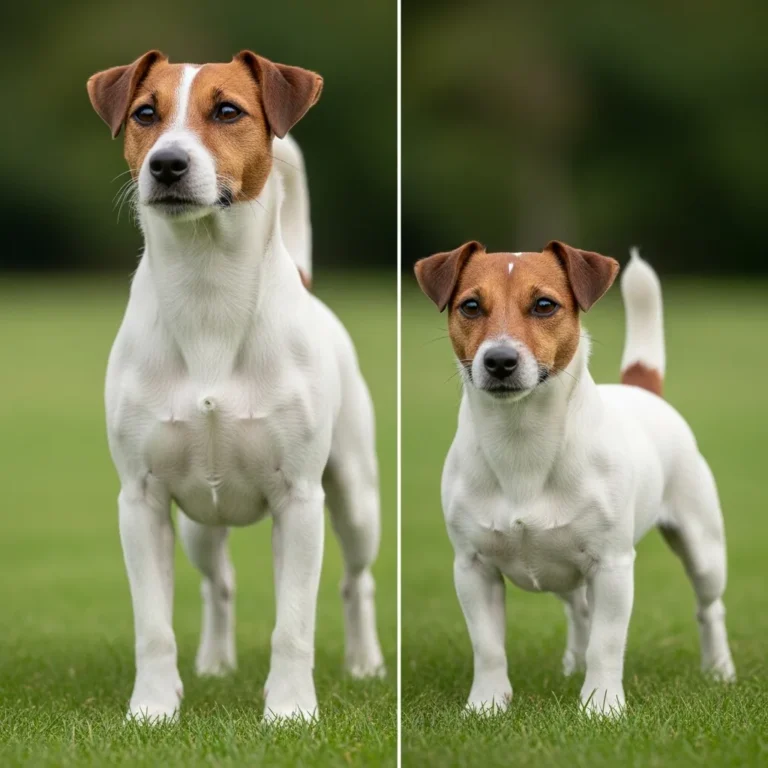
Even though they look similar at first glance, the biggest difference lies in the overall proportions:
- Parson Russell Terrier
- Taller (12–15 inches at the shoulder)
- More square-shaped body
- Longer legs
- Built with “show dog” proportions
- Jack Russell Terrier
- More varied in height (10–15 inches)
- Generally longer than tall
- A bit more rugged or variable in shape
- Built for working versatility
Think of the Parson as the elegant, longer-legged cousin, while the Jack Russell is the scrappier, “ready-for-anything” field dog.
Are Jack Russells and Parson Russells the same breed?
They share the same ancestral origin, but today:
- They are recognized as separate breeds by major kennel clubs like the AKC.
- JRTCA, the largest Jack Russell registry in the world, does not recognize the Parson Russell as the same breed.
Why the split?
It comes down to different breeding priorities:
- Parson Russell Terrier (AKC)
Developed along a consistent, square-shaped show standard. - Jack Russell Terrier (JRTCA)
Maintained as a working terrier with practical, flexible proportions for hunting.
Dr. Stanley Coren—renowned canine psychologist and author of The Intelligence of Dogs—explains that working lines and show lines often diverge because they emphasize different traits.
Why are there so many names (Jack Russell, Parson Russell, Russell Terrier)?
According to American Kennel Club;
Here’s the quick breakdown:
| Name | Registry | Description |
|---|---|---|
| Jack Russell Terrier | JRTCA | The “classic” working terrier; more size variation. |
| Parson Russell Terrier | AKC | Taller, square-bodied show breed derived from Jack Russells. |
| Russell Terrier | AKC | Shorter (10–12”), more compact “Australian-derived” version. |
This trio is why people often think they’re all the same.
Physical Appearance & Identification
How can I tell if my dog is a Jack Russell or a Parson Russell?
You can identify your dog by measuring three things:
1. Height at the Withers (Shoulder)
- Parson: 12–15 inches
- Jack Russell: 10–15 inches (wide working range)
2. Body Shape
- Parson: Square (height = body length)
- Jack Russell: Usually longer than tall
3. Chest Size
Working JRTs traditionally have narrower, more flexible chests to fit into fox dens.
Which breed is bigger: the Jack Russell or the Parson Russell?
The Parson Russell is almost always taller and appears more refined.
The Jack Russell tends to be:
- Shorter
- Longer-bodied
- A bit stockier or more varied
Both AKC and JRTCA confirm this difference in their official standards.
Do they have different coat types?
No — both breeds can have any of the following:
- Smooth Coat
- Broken Coat (a mix of smooth + rough)
- Rough Coat
Dr. Jerry Klein, Chief Veterinary Officer at the AKC, notes that coat type depends on genetics rather than breed category.
Temperament & Personality
Is a Parson Russell calmer than a Jack Russell?
Not exactly calm, but many owners report that:
- Parsons can be slightly more predictable or polished
because show breeders select for steadier temperaments. - Jack Russells can be more intense and reactive
because working lines focus heavily on drive and boldness.
A popular joke online says:
“The Parson is high energy; the Jack Russell is high energy on caffeine.”
Are they affectionate cuddly dogs, or independent workers?
They are both:
- Extremely affectionate with their people (true “velcro dogs”)
- Independent thinkers bred for decision-making underground
- Loyal but stubborn, especially if bored
Dr. Patricia McConnell, a respected animal behaviorist and author of The Other End of the Leash, notes that terriers love hard but operate on their own logic.
Do they bark a lot?
Yes. Both breeds are:
- Alert
- Vocal
- Quick to sound the alarm
- Easily stimulated by movement, noises, and strangers
This is normal terrier behavior and part of why they excel at watchdog duties.
Living Conditions & Suitability
Can a Jack Russell or Parson Russell live in an apartment?
They can, but it’s challenging.
According to the JRTCA and multiple professional trainers, the breed requires:
- Several hours of physical activity daily
- Mental challenges (puzzles, sports, scent work)
- A dedicated exercise routine
Without this, they can become:
- Destructive
- Barky
- Escape artists
- Overstimulated indoors
Are they good family dogs with children?
They can be great family dogs, but they do best with:
- Families who teach children gentle handling
- Older kids who respect boundaries
- Active homes
Rough play or grabbing can cause these terriers to snap defensively—common among all high-drive hunting breeds.
Can they live with cats or other small pets?
This is a high-risk situation.
Both Jack Russells and Parsons have:
- Very strong prey drives
- Lightning-fast reflexes
- Deep instinct to chase, corner, or dig after small animals
Early socialization may help, but never guarantees safety—especially around:
- Rabbits
- Guinea pigs
- Hamsters
- Birds
- Ferrets
- Outdoor cats
How much exercise do they actually need?
A lot. More than many first-time dog owners expect.
They need:
- Running or high-speed fetching
- Jumping or agility practice
- Off-leash sprinting in safe areas
- Terrier games (digging boxes, lure chasing)
- Structured training
- Problem-solving activities
Dr. Ian Dunbar, world-renowned dog trainer, emphasizes that terriers “don’t tire from walking—they tire from thinking and sprinting.”
Health & Care
What are the common health problems for Jack and Parson Russells?
According to VCA Animal Hospitals and Jack Russell Terrier Club of America JRTCA:
Both breeds are generally healthy but prone to:
- Patellar Luxation
- Primary Lens Luxation (PLL)
- Deafness
- Legg–Calvé–Perthes disease
- Atopy (skin allergies)
Reputable breeders test for:
- PLL
- CERF eye issues
- BAER hearing abnormalities
What is the life expectancy of these breeds?
They are famously long-lived:
- 13–16+ years is very common
- Many reach 17–18 years in good health
Do they shed a lot?
Yes. Even rough coats shed year-round, though smooth coats shed the most.
Daily brushing helps:
- Reduce loose hair
- Distribute skin oils
- Keep coats clean and healthy
Training & Intelligence
Are they easy to train?
They are extremely smart, but not “easy.”
Jack Russells and Parsons:
- Learn quickly
- Love challenges
- Get bored fast
- Ignore repetitive commands
- Need variety and mental enrichment
As Patricia McConnell often says, “Terriers ask what’s in it for them before they obey.”
Why is my terrier digging in the yard?
Because digging is wired into their DNA.
These breeds were created to:
- Tunnel underground
- Flush out foxes and small animals
- Follow scents
- Create escape routes
Digging is not a problem—it’s instinct.
To manage it:
- Create a designated dig pit
- Use sandboxes
- Offer scent games
- Supervise yard time
Suppressing the instinct usually backfires; channeling it works far better.
Conclusion
If you’re deciding whether a Jack Russell Terrier or a Parson Russell Terrier fits your lifestyle, keep this in mind:
- They share the same fiery terrier heart.
- Both are clever, affectionate, and endlessly energetic.
- The difference lies mostly in build, breeding purpose, and predictability.
- A Parson tends to be more structured in proportions and temperament.
- A Jack Russell is more variable, intense, and traditionally “working.”
Either way, both breeds offer huge personality packed into a small, athletic body—a combination that loyal owners adore for life.
Notice : The DogsBlogSS editorial team is dedicated to providing accurate, research-based information about dog health, behavior, and care. All our articles are fact-checked using trusted veterinary sources such as VCA Hospitals, Merck Vet Manual, and the AKC.
you may like it