Author: DogsBlogSS Team
⚠️ Disclaimer: This article is for informational purposes only and is not a substitute for consulting a veterinarian.
bordetella vaccine
Understanding the Basics
If you’ve ever planned to board your dog, book a grooming appointment, or join a doggy day-care program, chances are someone asked, “Do you have the Bordetella vaccine updated?” For many pet parents, this question sparks confusion—especially if their veterinarian hasn’t emphasized it the same way they do with core vaccines like Distemper or Rabies.
The vaccination bordetella is one of those special vaccines that sits in a “middle zone” between essential and optional, depending on a dog’s lifestyle. It protects against Bordetella bronchiseptica, a primary bacterial cause of kennel cough, a highly contagious upper-respiratory infection that spreads quickly wherever dogs gather.
Veterinary experts often describe it as the dog equivalent of catching a bad cold at preschool—except preschool, in this case, is a dog park full of sniffling, playful pups.
According to American Kennel Club, Bordetella is one of the most common reasons dogs develop that unmistakable “goose-honk” cough. The AKC’s health guidance confirms that many facilities insist on the vaccine to reduce outbreaks:
According to Best Friends Animal Society, veterinarian with Best Friends Animal Society, notes that dogs sharing airspace—even briefly—can pass Bordetella to one another through sneezes, shared water bowls, or simply sniffing the same toy. Their educational resource further explains kennel cough basics and prevention:
What is the Bordetella vaccine and what does it protect against?
According to American Kennel Club, The bordetella vaccine for dogs helps prevent respiratory illness caused by Bordetella bronchiseptica, which often teams up with viruses like parainfluenza to create kennel cough. Symptoms usually include:
- A dry, raspy, or honking cough
- Sneezing or nasal discharge
- Gagging after coughing
- Mild lethargy
The vaccine doesn’t promise 100% immunity (no vaccine does), but it significantly lowers the severity and duration of illness—and often prevents it entirely.
Is the Bordetella vaccine considered a core (mandatory) vaccine?
According to American Kennel Club, No. The Bordetella vaccine is a non-core vaccine, meaning it’s recommended based on lifestyle, not required for every single dog.
Still, many veterinarians call it strongly advisable.
Why is this vaccine often required for boarding kennels, groomers, and dog parks?
According to American Kennel Club, Because kennel cough spreads extremely fast in crowded, indoor or semi-indoor settings, many facilities require proof of vaccination. One coughing dog can start an outbreak that spreads through an entire boarding center in days.
That’s why:
- Boarding kennels
- Daycares
- Groomers
- Training centers
- Dog parks
- Group classes
…often ask for Bordetella documentation.
It’s not about bureaucracy—it’s about preventing mass illness in places where dozens of dogs breathe the same air.
Administration, Types, and Schedule
Once you know what the vaccine does, the next question is: How does my dog get it, and how often?
At what age can puppies receive their first Bordetella vaccination?
According to Merck Veterinary Manual, Most puppies can get their first Bordetella vaccine at 6 to 8 weeks old. This is especially important for puppies entering training classes or puppy daycare since their immune systems are still developing.
How often does my dog need the Bordetella booster: every 6 months or once a year?
According to petmd and Merck Veterinary Manual, It depends on your dog’s social life.
- High-exposure dogs (daycare, grooming, boarding often): every 6 months
- Moderate or low-exposure dogs: every 12 months
Veterinarians base the schedule on real-world risk, not a one-size-fits-all rule.
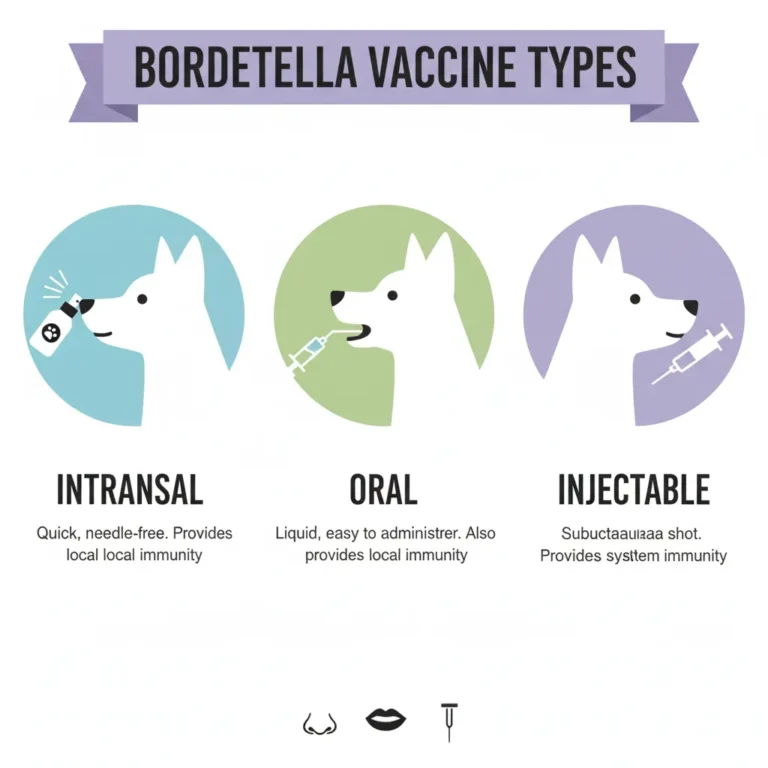
What are the differences between the Intranasal (nose spray), Oral, and Injectable Bordetella vaccines?
According to Revival Animal Health, There are three ways vets administer this vaccine, each with its own advantages.
Intranasal (Nose Spray)
- Fast immunity (typically within a few days)
- Often preferred for quick protection
- Mimics the natural entry point of the bacteria
Oral (Liquid in the Mouth)
- Easy for dogs who dislike nose sprays
- Similar immune response to intranasal
Injectable (Shot Under the Skin)
- Useful for dogs who can’t tolerate intranasal/oral methods
- Takes longer to reach full effectiveness (usually 10–14 days)
Is one method more effective or safer than the others?
All three methods are safe, but intranasal and oral versions generally provide faster and more targeted immunity because they stimulate local respiratory defenses. Injectable forms are equally safe but may take longer to build up protection.
Vets often choose based on:
- Your dog’s health
- Behavior during handling
- How quickly immunity is needed
- Facility requirements
Effectiveness and Immunity
How long does it take for the Bordetella vaccine to become fully effective?
- According to msd animal health and Veterinary Medicines Directorate, Intranasal or oral: 48–72 hours for noticeable immunity
- According to msd animal health and Veterinary Medicines Directorate, Injectable: 10–14 days for full protection
If you know you’re boarding your dog soon, vaccinate early.
Can my dog still get kennel cough even if vaccinated?
Yes, but typically:
- The cough is much milder
- Symptoms last a shorter time
- Complications (like pneumonia) are significantly reduced
Kennel cough isn’t caused by a single bacteria or virus. Bordetella is just one piece of the puzzle. This is why outbreaks can happen even in vaccinated communities.
This “strain coverage” issue is well-known among vets and often compared to the human flu shot—the vaccine may not cover every circulating respiratory germ, but it still offers strong protection.
Side Effects and Safety (Crucial Section)
This is the part most dog parents search for—and worry about. Fortunately, the Bordetella vaccine is considered very safe and well-tolerated.
What are the most common side effects of the Bordetella vaccine?
According to petmd, Typical side effects are mild and short-lasting:
- Sneezing
- Mild coughing
- Runny nose
- Fatigue
- Slight fever
- Reduced appetite for 12–24 hours
These usually appear after intranasal or oral vaccines, not injectable versions.
Is it normal for my dog to cough or sneeze after receiving the intranasal vaccine?
According to petco, Absolutely. The intranasal version is sprayed directly into the nostrils, so dogs may experience:
- Sneezing
- Reverse sneezing
- Minor coughing for a day or two
This is the body’s natural reaction to the droplets placed in the nose.
Are there any severe reactions or risks I should watch out for?
According to Stone Ridge Veterinary Services Ltd and Find A Vet Near You, Severe reactions are very rare. However, call your vet immediately if you notice:
- Facial swelling
- Hives
- Difficulty breathing
- Persistent vomiting
- Severe lethargy
These are signs of an allergic reaction, which could happen with any vaccine, not just Bordetella.
Can a recently vaccinated dog shed the bacteria and infect immunocompromised humans or other pets?
This question appears often—and understandably so.
Intranasal and oral Bordetella vaccines contain modified (weakened) live bacteria, which means minimal shedding is possible shortly after vaccination. But according to infectious-disease specialists, the weakened strain isn’t known to cause illness in healthy humans or animals.
However:
- Severely immunocompromised people should avoid very close contact (face-to-snout) with a dog for a few days after intranasal vaccination.
- Other dogs—especially sick or unvaccinated puppies—may be theoretically vulnerable, though documented cases are extremely rare.
Most clinics still consider it safe for multi-dog households.
https://academic.oup.com/ofid/article/10/8/ofad421/7238034?amp;login=false
https://www.vmd.defra.gov.uk/productinformationDatabase/files/QRD_Documents/QRD-Auth_1119164.PDF?
Cost and Logistics
How much does the Bordetella vaccine typically cost?
Prices vary based on your region and clinic type:
- General veterinary clinics: $30–$50
- Low-cost vaccine clinics: $15–$30
- Mobile clinics or shelters: sometimes $10–$20
Some grooming and boarding facilities also offer on-site Bordetella vaccinations for convenience.
When comparing costs, remember:
- Intranasal and oral may cost slightly more.
- Injectable is often bundled with other vaccines.
But overall, it’s one of the more affordable vaccines—and often required for many dog services.
Notice : The DogsBlogSS editorial team is dedicated to providing accurate, research-based information about dog health, behavior, and care. All our articles are fact-checked using trusted veterinary sources such as VCA Hospitals, Merck Vet Manual, and the AKC.
you may like it